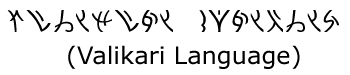
 Valikari SurielinSurielin is pronounced soo-ree-ay-leen. |
The Origins of Valikari™While the Valikari tongue achieved widespread renown across the expanse of Tales of the Misplaced, its ancient roots actually originated in the realm of Flames of the Phoenix. Though these stories take place in entirely separate universes, they share this foundational linguistic bond. |
General InformationValikari is a constructed language created by Adam K. Watts for use in his fiction. Although it originated in Flames of the Phoenix and later became a prominent part of Tales of the Misplaced, Valikari has developed into a comprehensive, usable language with its own vocabulary, grammar, pronunciation, word-formation system, and written script. Valikari was designed to be practical as well as expressive. Its systematic structure allows existing words and concepts to form the basis for related meanings, while its vocabulary provides distinctions appropriate to the cultures and perspectives of those who speak it. Valikari is not limited to the Mikurien Universe or Adam K. Watts's fiction. Authors and other creators are welcome to use the language in their own original works in accordance with the Rules for Use provided below. Language StructureThe written language of Valikari is logical and phonetic. Every Valikari character represents one sound only, and every sound used in Valikari is represented by a single character. What does this mean? In English, many letters represent more than one sound. For example, the letter C can sound like an S or a K. English also uses combinations of letters to represent individual sounds. In Valikari, each of these sounds has its own character. Sounds represented in English by combinations such as CH, SH, TH, and NG can therefore be represented by single Valikari characters. Valikari uses 34 unique sounds and therefore has 34 characters: 9 vowels and 25 consonants. Successive vowels are pronounced individually rather than combining to form a different sound, and Valikari does not use silent letters. Every character receives its full pronunciation. Valikari may also be written using Latin characters. Where a Valikari sound does not have a direct English equivalent, combinations of Latin characters are used to represent it. For example, JH is used to represent the soft J sound. This allows Valikari to be written and exchanged without requiring the Valikari font or native script. Valikari also uses a systematic grammar and word-formation structure. Related concepts can be expressed through established grammatical forms, affixes, and combinations of existing words, allowing the language to expand while maintaining internal consistency. Complete rules for grammar, pronunciation, word formation, and usage are provided in the Valikari Language Reference. Pronunciation: Valikari pronunciation is most similar to Japanese or Spanish, although some Valikari sounds do not exist in one or the other of those languages. |
Valikari™ Open Source Language License & Terms of UseThe Valikari™ language is the foundational linguistic heart of Flames of the Phoenix and the Tales of the Misplaced™ series. To support the indie publishing community, the speculative fiction writer space, and world-builders worldwide, the core structure, dictionary assets, and grammar rules of Valikari are distributed free of charge under an Open Source Author Agreement. Use of this language in any original creative or commercial work indicates your implicit consent to the following terms, conditions, and restrictions: Core Community Rules (The 5 Commandments)
Macro-Universe Intellectual Property Restrictions
|
|
Note: Requested concept additions to the lexicon are not guaranteed to become canon. |
|
Access to the downloadable Valikari materials requires acceptance of the Rules for Use above. Downloads
|
Sounds and the AlphabetThe charts below show which keyboard values are assigned to the Valikari characters and the sounds that the characters represent. Above each Valikari character is the key to which the character value is assigned. Below the Valikari character is a pronunciation hint. Note that some of the characters are assigned to more than one keyboard key. You will note that Valikari utilizes neither silent letters nor diphthongs. Every letter receives full pronunciation. For a comprehensive explanation of Valikari phonetics and mapping those phonetics to the associated Valikari character using your keyboard and the Valikari font, download the Valikari Language Reference above. |
Vowels:
Consonants: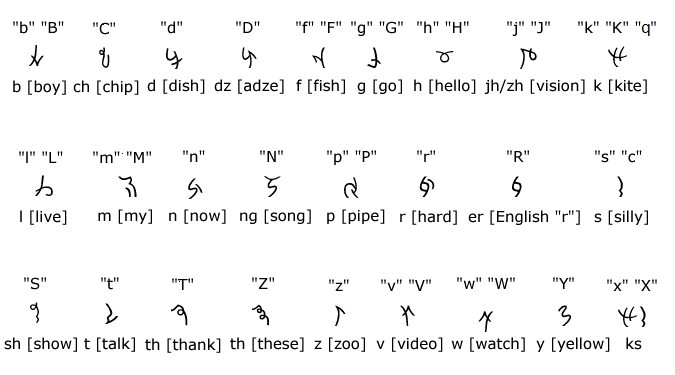
Numbers and Symbols: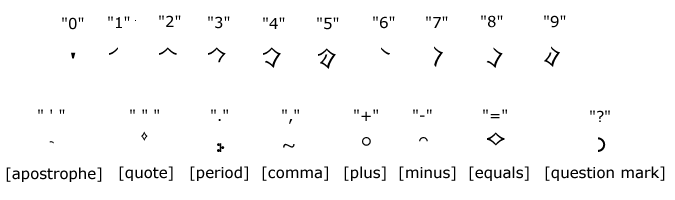 |
Valikari Questions and Concept RequestsHave a question about Valikari, need help expressing something, or encountered a concept that does not appear to be adequately represented? Use Valikari Questions & Concept Requests to contact us. Questions about individual words, expressions, pronunciation, grammar, and correct usage are welcome. If you are requesting a new concept, describe what you need to express and, where useful, provide an example or context. Existing Valikari vocabulary and constructions will be considered first. Where a genuine gap exists, an appropriate canonical term or construction may be developed. For longer passages or dialogue, the Valikari reference materials are intended to help you compose your own text. This service is not intended for full-scene or manuscript translation. |